Before you choose broadband: five things that matter most
Choosing broadband is rarely about finding the highest speed or the lowest price first. For most people, it is more important to find a solution that actually fits the home, the address and the way the internet is used in everyday life.
Broadband at home should handle everything that happens at the same time: video meetings, streaming, homework, gaming, smart TV and phones that are always connected. If you live alone in a small apartment, your needs are often different from a family in a detached house with many rooms and many screens.

At the cabin, the decision is a little different. Broadband for the cabin first and foremost has to work where the cabin actually is. Coverage, data allowance, power access and how often you stay there can matter more than whether the subscription looks fast on paper.
A good broadband choice therefore starts with a simple question: what do you need the internet for, and where will you use it? Once you understand your actual broadband needs, it becomes much easier to choose between fiber, wireless broadband and mobile broadband without paying for more than you need.
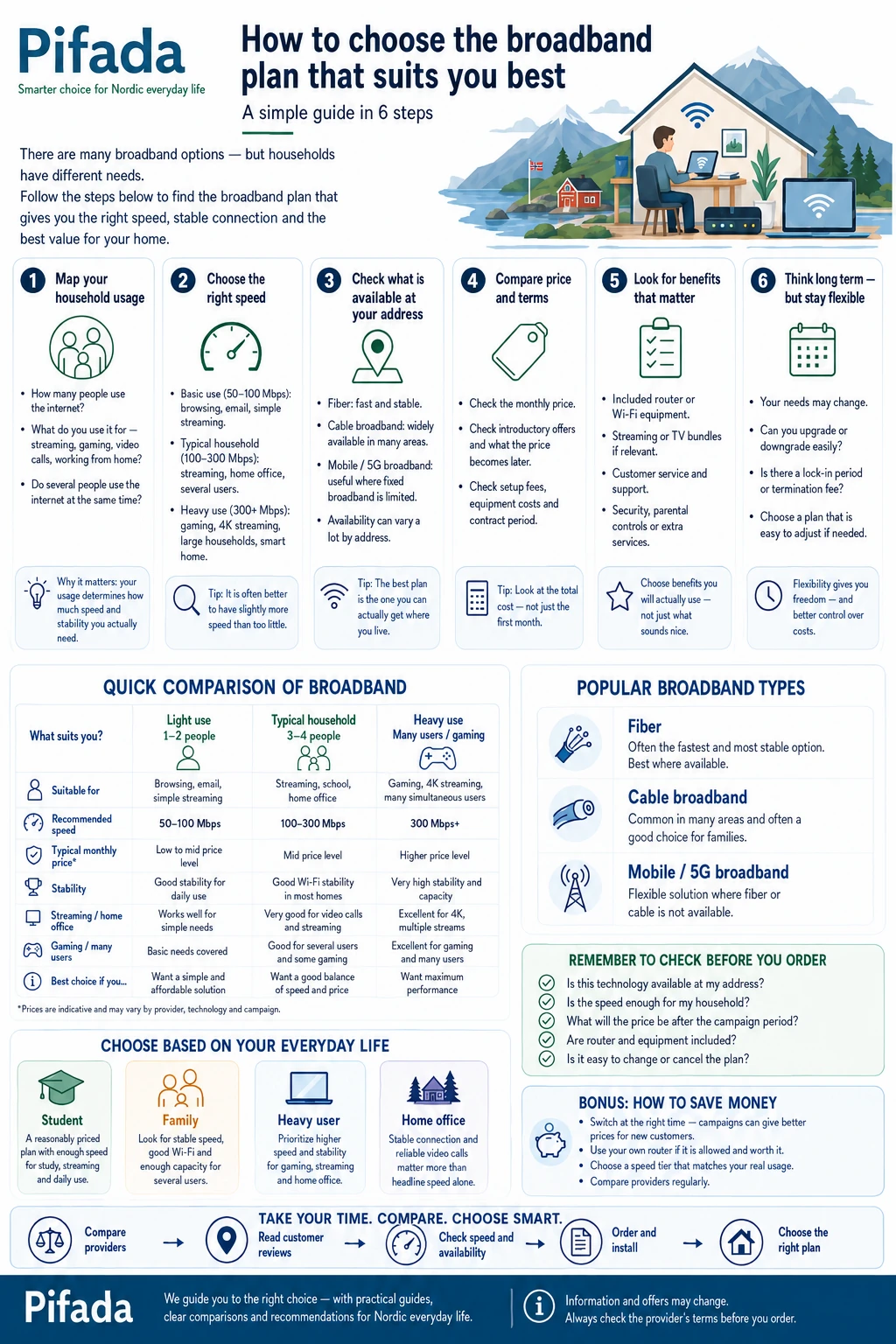
Before you choose broadband: five things that matter most
Before you start comparing broadband prices, it is worth checking a few things that actually decide whether a subscription fits. The cheapest broadband can be a good choice, but only if it works reliably where you live and covers your needs.
- Whether you can get fiber at your address: Fiber broadband is often the safest choice at home, but it does not help much if your home is not connected to a fiber network.
- How many people use the internet at the same time: One person with some streaming needs something different from a family with home office, gaming, smart TV and several phones online.
- Where the internet will be used: Broadband at home, broadband at the cabin and temporary internet in student housing can require different solutions.
- Coverage if you are considering 4G or 5G: Wireless broadband and mobile broadband can work very well, but only if the signal is good enough where you will use it.
- Total price, contract period and router: Look beyond the monthly price. Check the promotional price, regular price, contract period, setup costs and whether a router is included.
If you start with these five points, the choice becomes much easier. Then you are not just comparing offers that look good in an ad, but solutions that may actually fit your home, cabin and everyday life.

What kind of broadband suits you?
There is no single broadband plan that fits everyone. What works well in a small apartment can be too weak in a detached house with many screens. And what works fine at home is not necessarily the right solution at the cabin.
Start with your actual use before you look at speed and price. Once you roughly know how much broadband you need, it becomes easier to choose a solution that is practical enough without paying for more than you actually use.
For a small apartment
If you live alone or with one other person, you often do not need the biggest package. Ordinary browsing, online banking, music, video meetings and streaming usually work well with a moderate speed, as long as the connection is stable.
Here it is often smarter to look for a simple plan with a fair price and little hassle, rather than paying extra for speed you rarely notice. But if the Wi-Fi signal is poor in the apartment, buying faster broadband does not always help. The router may be the problem.

For a family with many devices
In a family home, the need quickly becomes larger. One person watches TV, one plays games, someone has a video call, and several phones and tablets are connected at the same time. Then broadband at home is less about top speed alone, and more about stability throughout the home.
Pay special attention to whether the router covers all rooms, and whether the speed holds up when many people use the internet at the same time. For families, a slightly more robust subscription is often worth more than the very lowest monthly price.
For working from home
If you work from home several days a week, broadband should be something you do not have to think about. Video meetings, large files and unstable internet are a bad combination, especially if others in the home use the connection at the same time.
When you ask what broadband speed you need, you should also ask how reliable the connection is. Consistent speed and good Wi-Fi can be more important than a high number in the advertisement.

For the cabin
Broadband for the cabin is its own decision. First you need to check what actually works where the cabin is located. Coverage, signal, power access and how often you use the cabin matter a lot.
If you are there only a few weekends a year, mobile or wireless broadband may be enough. If you use the cabin during holidays, work from there or have children streaming when the weather says “indoor weekend”, you should look more closely at data allowance, stability and router placement.
For temporary housing or student life
If you live somewhere temporarily, study or are waiting for a more permanent solution, flexibility may be more important than maximum speed. Then mobile broadband or wireless broadband can be practical, especially if you want to avoid installation and a long contract period.
Still, read the terms carefully. A cheap solution can become less good if the data allowance is too low, the contract period is long, or the coverage is weak exactly where you live.
Fiber, wireless or mobile broadband?
When you look for broadband, you quickly meet several terms that sound quite similar. Fiber broadband, wireless broadband and mobile broadband can all give you internet access, but they do not fit exactly the same use.
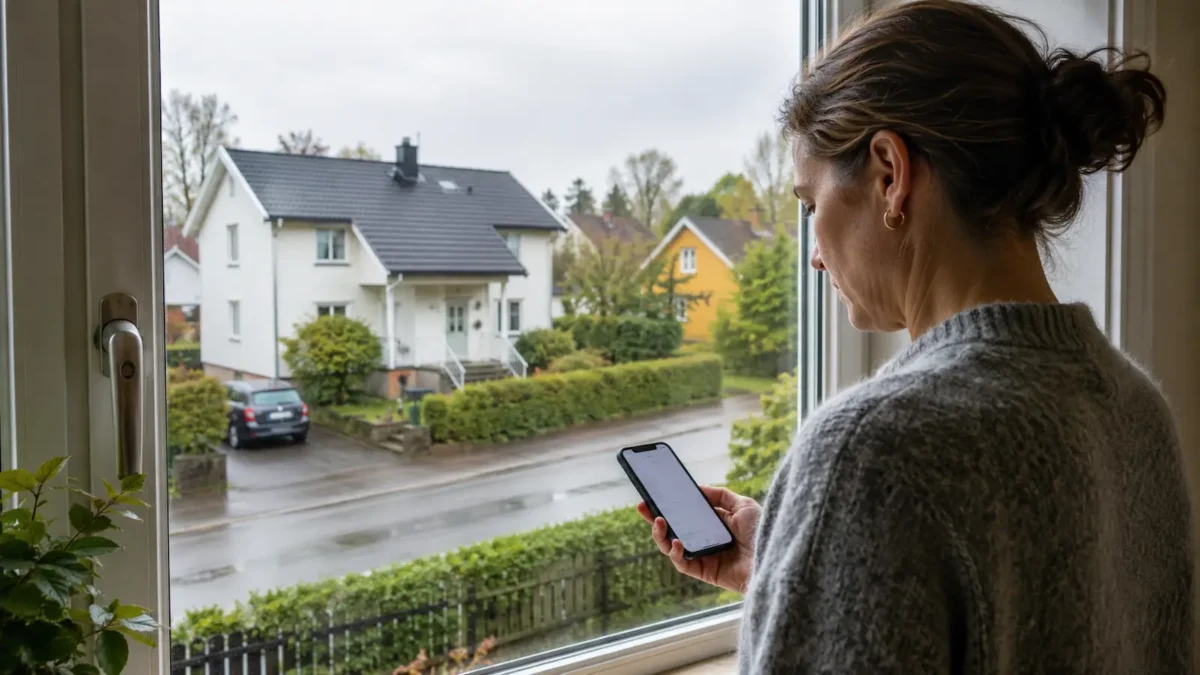
The difference between fiber and broadband is simple: broadband is the general term for the internet connection, while fiber is one way to get broadband. A bit like “car” is the vehicle, while “electric car” is one type of car.
Fiber broadband
Fiber broadband is often the best choice when you want stable internet at home. It suits homes where several people use the internet at the same time, or where the connection needs to work well for home office, streaming and gaming.
The downside is that fiber is not available everywhere. Before you compare broadband vs. fiber in practice, you therefore need to check whether your address can actually get fiber.
Wireless broadband over 4G or 5G
Wireless broadband uses the mobile network, but is designed as a home internet solution. It can be a good alternative if you do not have fiber, or if you want to avoid installation with a cable into the home.

Here, coverage matters a lot. A good 5G signal can give a smooth and simple solution, while a weak signal can make the internet unstable. The router should also be placed where the signal is actually good, not just where it looks neat.
Mobile broadband
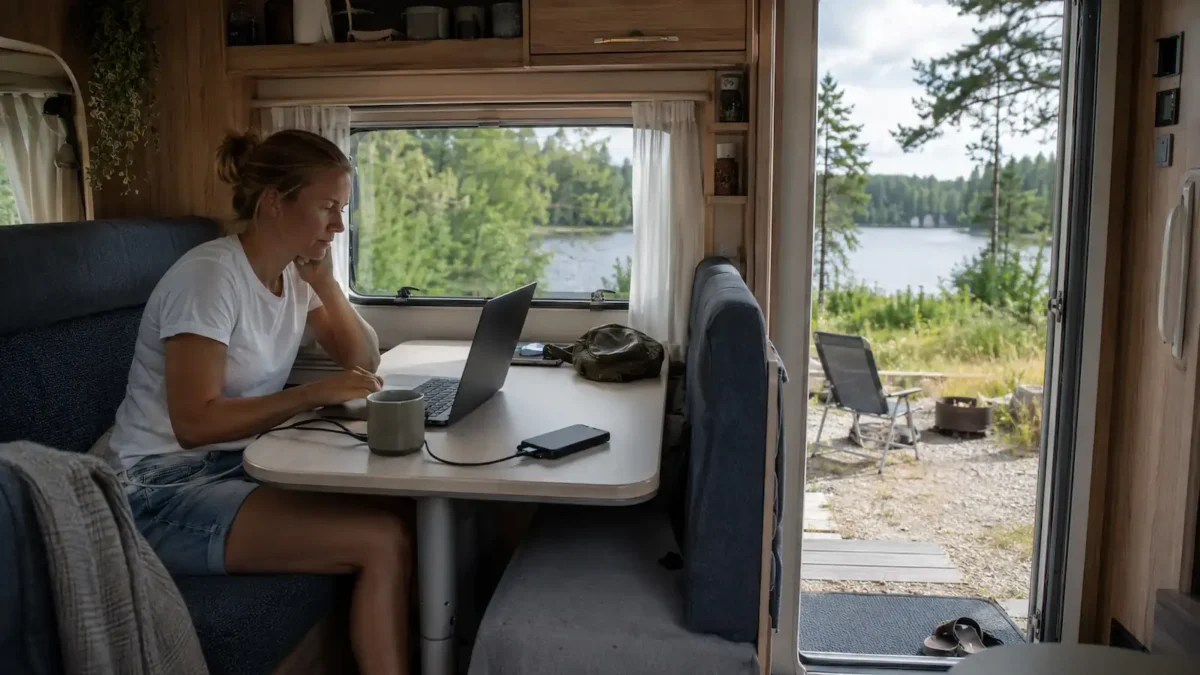
Mobile broadband is the most flexible solution. It is usually used with a SIM card in a small router, and can suit the cabin, campervan, temporary housing or as extra internet when you need something easy to take with you.
What you need to watch is data allowance and coverage. Mobile broadband can be smart when use is moderate or occasional, but less ideal if many people stream a lot every day.
| Type of broadband | Best suited for | Be careful if |
|---|---|---|
| Fiber broadband | Homes with high or stable internet needs | Fiber is not available at the address |
| Wireless broadband | Homes without fiber, or where simple installation matters | 4G or 5G coverage is weak |
| Mobile broadband | Cabin, campervan, student life or temporary use | You stream a lot or need very stable internet every day |
How fast does your internet really need to be?
Broadband speed is one of those things it is easy to buy too much of. A high number feels safe, but in everyday use you do not always notice the difference between a good enough speed and a much more expensive package.
| Use | Approximate speed to look for |
|---|---|
| Simple use such as online banking, email and ordinary browsing | 50–100 Mbps can often be enough |
| Small apartment with streaming and some video meetings | 100 Mbps is a good place to start |
| Family with several screens and devices | 250 Mbps or more often gives a smoother experience |
| Gaming, home office and a lot of streaming at the same time | 250–500 Mbps can make sense |
| Large home with many rooms and many users | 500 Mbps can be useful, but Wi-Fi coverage is just as important |
If the internet feels slow, you can measure the actual speed with Nettfart. Test several times and at different times of the day. This makes it easier to see whether the problem is the broadband connection itself, Wi-Fi coverage at home or heavy use when many people are online at once.

When you wonder what broadband speed you need, think about more than the number in the subscription. If you live alone, 50 Mbps or 100 Mbps broadband can work well. If you have many devices, home office and several people streaming at the same time, 500 Mbps broadband can make everyday life calmer.
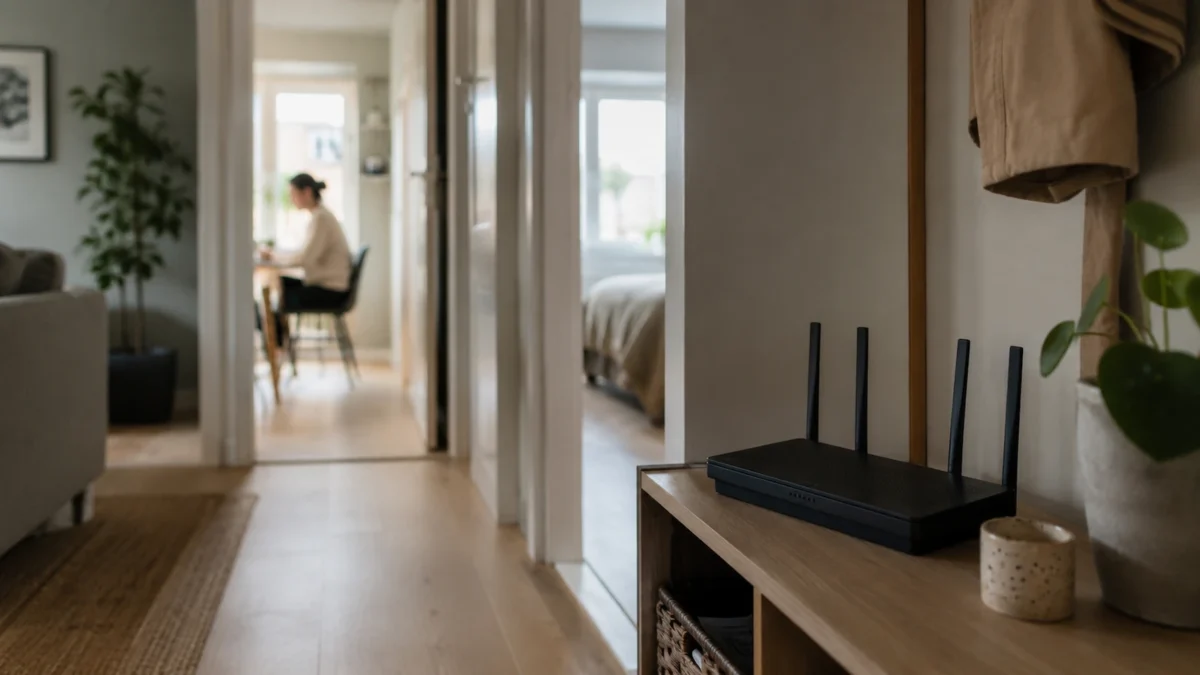
But speed does not solve everything. A weak router, thick walls or poor placement of Wi-Fi equipment can make the internet feel slow even if the subscription is fast. Before paying for more speed, it is worth checking whether the real problem is Wi-Fi coverage at home.
Price, contract period and terms: what often matters most
It is natural to look at price first. Broadband is a fixed monthly cost, and nobody wants to pay more than necessary. But when you compare broadband prices, you should look a little further than the number shown largest in the advertisement.
Do not look only at the monthly price
A low monthly price can be a good sign, but it does not tell the whole story. An affordable broadband subscription can become less affordable if you have to pay extra for setup, installation, delivery or a router.
Also look at what you actually get. The cheapest broadband is not always cheapest in practice if the speed is too low, the Wi-Fi equipment is weak or the solution does not suit your home.
Promotional prices can be a little misleading
Many offers look especially good for the first few months. That is not necessarily a problem, but you should always check what the price becomes after the promotional period. The regular price is the one you will live with for the longest time.
A good offer should still make sense when you calculate the whole year, not just the first invoice. When you assess broadband price, the total cost is often more useful than the promotional price alone.
Contract period and router should be checked before you order
Broadband without a contract period can be smart if you live temporarily, study, rent or know that you may move. If your housing situation is stable, a contract period can be fine, but only if the agreement actually suits you.
Before you commit to an agreement, read the terms calmly. Check especially the regular price after the promotion, contract period, setup costs and what happens if you move. Forbrukerrådet has general guidance on complaints and consumer rights if a service does not work as agreed.
The router is also more important than many people think. A good connection into the home does not help much if the Wi-Fi does not cover the rooms where you use the internet most.
Check this before you order:
- current monthly price
- regular price after the promotional period
- contract period
- setup, installation or delivery costs
- whether a router is included or costs extra
- any data or speed limits
The best choice is rarely just “the cheapest broadband”. It is the agreement that gives enough speed, good enough terms and a price that still feels right when the promotion is over.
Coverage: why you should check the address first
There is no single broadband solution that is best for everyone in Norway. Two homes in the same municipality can have very different options, and sometimes even your neighbour can get a solution you cannot.
Fiber depends on whether your address is connected to a fiber network. If it is not, it does not help much that fiber looks best on paper. Then wireless broadband or mobile broadband may be more relevant.
With 4G and 5G, broadband coverage is especially important. A coverage map for mobile broadband can give a useful indication, but it does not always tell the whole truth. Mountains, forest, thick walls, distance to the mast and where the router is placed at home can affect the experience.
When you consider wireless broadband or mobile broadband, do not rely only on advertising. Start by checking coverage where the internet will actually be used. Nkom has public information about mobile networks and electronic communication in Norway, and is a useful place to start if you want to understand why coverage can vary.
This is especially noticeable at the cabin. Coverage there can be completely different from at home, and small differences in placement can matter a lot. Sometimes the internet works well by the window, but poorly in the middle of the room. A little inconvenient, but quite typical.
When you wonder “which broadband can I get”, the first step should therefore be to check broadband at your address. Only then does it make sense to compare price, speed and terms.
Pifada’s advice: Do not choose broadband before you have checked what is actually available where you live or where the cabin is located. The best offer is not particularly good if the coverage does not hold up in practice.
Broadband at the cabin
Broadband at the cabin should be chosen a little differently from broadband at home. At the cabin, the highest speed is not always what matters most. Often it is more about coverage, data allowance, power access and how much the cabin is actually used.
If you use the cabin now and then
If the cabin is mostly a place for weekends and holidays, mobile broadband at the cabin can be a practical solution. You often avoid fixed installation, and you do not necessarily pay for a heavy solution you use only a few times a month.
Still, check the data allowance. A little email, weather forecast and news require little. Streaming, tablets and children who “just want one more episode” quickly use more than you think.
If you work from the cabin
If you use the cabin as a home office, you should be more selective. Video meetings, file uploads and unstable coverage are a bad combination, especially if the cabin is in a place where the signal varies with weather, terrain or where in the room the router is placed.
Wireless broadband at the cabin can be a good choice if the coverage is stable enough. But test or check coverage thoroughly before committing. A solution that works well for evening streaming is not always good enough for a working day.
If the family streams a lot
For families, cabin broadband is often about peace and quiet. When the weather turns bad and everyone comes inside, the internet can quickly be used more than planned. Then it is worth thinking about both speed and data allowance before you choose.
If many people will stream, play games or use tablets at the same time, avoid the smallest and cheapest solution just because it looks fine on paper. At the cabin, weak internet is especially noticeable because there are often fewer alternatives.
Check especially:
- coverage where the cabin actually is
- data allowance and any limits
- where the router can be placed for the best signal
- whether the cabin has stable power access
- whether the agreement can be paused, changed or used flexibly
Wi-Fi, router and your home
A common misunderstanding is that broadband and Wi-Fi are the same. They are not. Broadband is the connection into the home. Wi-Fi is the wireless network that distributes the internet to phones, computers, TV and everything else that connects.
That means you can have a good broadband subscription and still experience slow internet at home. The problem may be the router, where it is placed, thick walls, floors or too many devices competing for the same signal.
This also applies if you use mobile broadband with a Wi-Fi router. The mobile coverage itself must be good, but the router also needs to stand somewhere the signal actually reaches well. At the cabin, that may mean by a window. At home, it may mean more centrally in the home, not hidden behind the TV stand.
Check this before blaming the broadband:
- is the router placed openly, or hidden behind furniture?
- is the internet worst far away from the router?
- is the problem only on Wi-Fi, or also with cable?
- do you have many devices connected at the same time?
- does the home need better coverage, for example with mesh?
When people search for broadband vs. Wi-Fi, it is often because the internet feels slow without them knowing why. Then it is useful to separate the broadband connection itself from the Wi-Fi coverage at home. Sometimes you do not need faster broadband. You just need better router placement.
When mobile broadband is smart — and when it is not
Mobile broadband can be a very practical solution, but it does not suit everyone. The short explanation of what mobile broadband is: you get internet through the mobile network, often with a SIM card in a small router or portable device.
The advantage is flexibility. The downside is that you become more dependent on coverage, data allowance and terms than with fixed broadband at home.
When mobile broadband works well
Mobile broadband is especially smart when you need internet somewhere fixed installation is impractical, expensive or unnecessary. It can also be useful if you want a solution you can take with you.
- at the cabin or in a campervan
- in temporary housing
- for students who do not want to commit for a long time
- as extra internet if the home connection is unstable
- when your use is moderate and you do not stream heavily every day
When you should be a little careful
There are especially three things to check: coverage, data allowance and what happens with heavy use. Mobile broadband with unlimited data can sound simple, but read the terms. Some agreements may have speed reductions or other limitations after a certain amount of use.
- if many people in the household will stream at the same time
- if you game and need low latency
- if you work from home and need stable internet all day
- if coverage is weak where the router will stand
- if you are unsure how many GB you need on mobile broadband
Mobile broadband prices can look tempting, especially if you compare them with fixed broadband. But always calculate based on your own use. A little browsing and news uses little data. Streaming, video meetings and children with tablets use more than many people expect.
Common mistakes when choosing broadband
It is easy to choose broadband a little too quickly. Often you see a low price, a high speed or a neat promotional offer, and think the decision is made. But small details can matter a lot in everyday life.
Only looking at the lowest price
The cheapest broadband can be right if your needs are simple and the coverage is good. But a low price alone says little about stability, router, contract period and what the subscription actually costs after the promotion.
Buying more speed than you need
High broadband speed feels safe, but you do not always get more value from the most expensive package. If you live alone and use the internet normally, a moderate speed can be more than enough.
Forgetting the router and Wi-Fi
Sometimes the problem is not the broadband, but the Wi-Fi at home. A poorly placed router, thick walls or weak coverage in certain rooms can make the internet slow even with a good subscription.
Not checking coverage
This is especially important for wireless and mobile broadband. Coverage needs to be good where you will actually use the internet, not just in the municipality or area in general.
Not reading contract and promotional terms
Broadband without a contract period can be worth looking for if you rent, study or may move soon. If the subscription has a contract period, you should know how long you are committing, what the regular price will be, and what it costs to cancel or change the agreement.
If the broadband does not work as the provider promised, first document the problem and contact the provider in writing. If the issue is not resolved, Forbrukerrådet’s complaint guide can be useful.
How we would choose broadband
If we were choosing broadband from scratch, we would not start by searching for “best broadband” right away. First, we would find out what is actually available, and what the internet needs to handle in everyday life.
- Check the address first. Find out whether you can get fiber, wireless broadband or other solutions where you live. For the cabin, check coverage where the cabin actually is.
- Choose the type of broadband. Fiber often suits stable internet at home best. Wireless broadband can be good without fiber. Mobile broadband is best when flexibility matters.
- Assess actual use. Think about how many people use the internet at the same time, whether you work from home, stream a lot, game or only need simple internet for everyday use.
- Compare total price. A good broadband comparison should include monthly price, promotional price, regular price, router, setup costs and any contract period.
- Read the terms before ordering. Check contract period, speed limits, data allowance and what happens if you move or want to change the subscription later.
A good broadband overview does not only help you find a low price. It should also make it clear which solution fits your broadband needs. Only then does the choice become easier — and a little less annoying to live with afterwards.
How we assessed this
This guide is a research-based assessment, not our own test of broadband subscriptions. We have not measured speed in homes from all providers or tested coverage at different addresses. Instead, we explain what usually matters most when choosing broadband in Norway.
We assess broadband based on practical criteria such as availability, stability, speed, price, contract period, data allowance, router, Wi-Fi and whether the solution fits best at home, at the cabin or for more flexible use. The goal is not to name one winner for everyone, but to make it easier to choose what is right for your everyday life.

Frequently asked questions about broadband
What is broadband?
Broadband is the internet connection you use at home, at the cabin or another fixed place. It can be delivered in several ways, for example through fiber, cable, wireless broadband or mobile broadband. For you as a user, the most important thing is that the connection is stable enough for what you actually do in everyday life.
What is the difference between fiber and broadband?
Broadband is the general term for the internet connection. Fiber is one type of broadband. Fiber often gives very stable internet and suits homes with many users, home office, streaming and gaming. But you need to be able to get fiber at your address, and not everyone can.
What is the difference between wireless broadband and mobile broadband?
Wireless broadband is often used as a fixed solution at home, but runs through the mobile network, usually 4G or 5G. Mobile broadband is more flexible and can often be taken between places, for example home, cabin or campervan. Both depend on good coverage, but mobile broadband often requires a little more attention to data allowance.
What is the difference between broadband and Wi-Fi?
Broadband is the internet connection into the home. Wi-Fi is the wireless network that distributes the internet inside the home. If the internet feels slow, it does not always mean the broadband is poor. The problem may also be the router, its placement or weak Wi-Fi coverage in certain rooms.
How fast does my broadband need to be?
It depends on how many people use the internet and what you use it for. Simple use and ordinary streaming often require less than people think. Several people, home office, gaming and a lot of streaming at the same time require more. As a rough guide, 50–100 Mbps can be enough for light use, while families and homes with many devices should often look higher.
How much does broadband cost per month?
The price varies with type of broadband, speed, address, promotion and terms. Always look beyond the monthly price. Regular price after the promotional period, contract period, setup costs, router and any data limits can make an agreement more expensive than it first appears.
Who can deliver broadband to my address?
This must be checked at your address. Fiber, wireless broadband and mobile broadband have different coverage, and availability can vary a lot from place to place. Always start with the address before comparing price and speed.
Is mobile broadband good enough at home or at the cabin?
Mobile broadband can be good enough if coverage is good and the use is not too heavy. It often works well at the cabin, in a campervan, in student housing or as a temporary solution. If many people will stream, game or work online reliably every day, check data allowance, speed and coverage extra carefully.
Sources and further reading
This guide is based on public information, consumer guidance and open sources about broadband, internet speed, coverage and contract terms. Availability, prices and terms can change, so we always recommend checking updated information with the provider before ordering.
- Nkom: Consumer information about internet — used for explanation of broadband, fixed broadband, mobile broadband and internet access.
- Nettfart — used as an independent tool to measure your actual broadband speed.
- Nkom: Consumer rights — used for general background on rights related to broadband and other communication services.
- Forbrukerrådet’s complaint guide — relevant if the broadband does not work as agreed, or if you disagree with the provider about price, delivery or terms.