Electricity plans in Norway: five things that decide what you actually pay
A good electricity plan is not only about the lowest electricity price right now. For most households, it is more useful to understand what you actually pay for: plan type, markup, monthly fee, grid tariff, price area and how much electricity you use during the year.

Electricity plans in Norway: five things that decide what you actually pay
Before you switch electricity supplier or choose Norgespris, it is worth checking these points first:
- Spot price often suits you if you can tolerate price variation and prefer to follow the market instead of paying extra for fixed predictability.
- Fixed price or Norgespris may be better if you want a clearer idea of what electricity will cost going forward.
- Markup and monthly fee matter a lot for the total cost, especially when a plan is marketed as cheap electricity or electricity with no markup.
- Grid tariff comes in addition no matter which electricity supplier you choose. It does not disappear when you switch plan.
- Usage, home type and price area decide whether a plan actually fits you. The cheapest electricity for one household is not necessarily the cheapest for another.
This guide is for you if you need to order electricity, switch supplier, consider Norgespris or simply understand why your electricity bill was higher than expected.
What is included in an electricity bill?
Your electricity bill is not only the price of the electricity you use. It consists of several parts, and this is often where the confusion starts. When people search for electricity price or price of electricity, they often mean the whole bill. But the electricity price, grid tariff, markup, monthly fee and taxes are not the same thing.
If you want to know whether an electricity plan is actually good, you need to look at more than one number. Two plans can both be spot price plans and still lead to different bills because the markup, monthly fee and terms are different.
A simple way to think about it:
Electricity bill = electricity price + markup + monthly fee + grid tariff + taxes
The total is what decides what you actually pay — not only the electricity price shown in an ad.
Electricity price is the price of the energy itself
The electricity price is the price of the energy you use. If you have a spot price plan, the price follows the power market. If you have a fixed price plan, you pay an agreed price for a specific period. If you choose Norgespris, a fixed price applies to the electricity consumption itself within the rules of the scheme.
The electricity price can change with the market, season, weather, consumption and production. NVE/RME explains that the price is set where supply and demand meet, and that it is affected by factors such as time of day, weather conditions and access to different energy sources.
That is why “electricity price right now” is not enough to choose a plan. Today’s price tells you something about the moment. Your electricity plan decides how you pay over time.

Grid tariff is the price of getting electricity delivered to your home
The grid tariff is what you pay the grid company for transporting electricity to your home. This part of the bill does not disappear when you switch electricity supplier.
That is because the electricity supplier and the grid company have different roles. The supplier sells you electricity. The grid company owns and operates the local power grid in your area. You can choose electricity supplier, but you normally cannot choose grid company.
NVE/RME describes grid tariff as payment for electricity transport and grid operation. They also explain that the electricity bill normally consists of three main parts: grid tariff, electricity and taxes.
This matters when you compare electricity and grid tariff. A new electricity plan can give you a lower markup or better terms, but it does not change which grid company you have. You still need to pay the grid tariff.
Markup and monthly fee are often where the real difference is
The markup is an extra charge the electricity supplier adds on top of the electricity price. It can be an amount per kWh, a fixed monthly amount, or both.
The Norwegian Consumer Council explains that markup is a price addition electricity suppliers charge on top of the spot price, and that it can be shown as a fixed amount and/or an amount per kWh.
This is why two spot price plans are not necessarily equally cheap. Both may follow the market price, but one can have a low markup and no monthly fee, while the other can have a higher markup, a fixed monthly fee or extra services you do not really need.
For a small apartment, a high monthly fee can matter a lot because the consumption is low. For a large detached house with high electricity use, the markup per kWh can become more important. Always look at the markup, monthly fee and your own usage before choosing.

Taxes and VAT are also part of the bill
Part of the electricity bill is taxes, not payment to the electricity supplier. NVE/RME lists VAT, electricity tax and the Enova fee as parts of the taxes on the electricity bill.
This means that the supplier cannot compete on the entire electricity bill. When you switch supplier, you mainly affect the plan type, markup, monthly fee and terms. Grid tariff and taxes follow other rules.
That does not make comparison less important. Quite the opposite. When several parts of the bill are difficult to influence, it becomes even more important to choose an electricity plan where the parts you can influence are simple, clear and reasonable.
Before you decide whether your electricity plan is expensive or cheap, check this:
- What do you pay for the electricity itself?
- How high is the markup per kWh?
- Does the plan have a fixed monthly fee?
- What do you pay in grid tariff?
- Are parts of the bill taxes you cannot opt out of?
Spot price, fixed price and Norgespris: what is the difference?
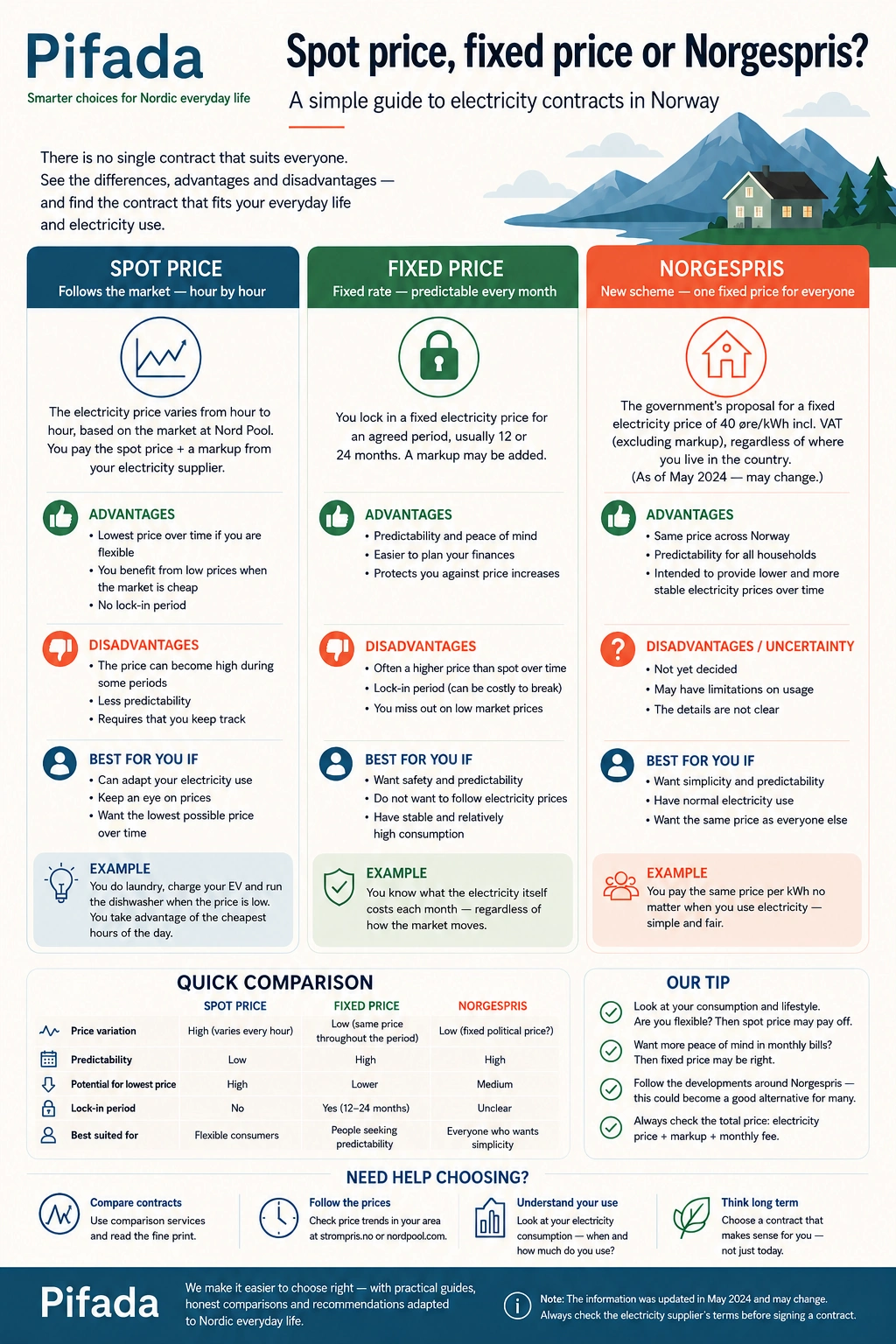
The main difference between electricity plans is how much risk you take yourself, and how much predictability you pay for. Spot price follows the market. Fixed price gives you an agreed price for a period. Norgespris is a state scheme with a fixed price on the electricity consumption itself. Variable plans also exist, but they should be checked extra carefully.

The question is not only which plan is cheapest right now. The better question is: How much variation can you tolerate, and how important is it that the electricity bill becomes more predictable?
Spot price electricity follows the market hour by hour
With spot price electricity, you pay the market price for electricity, plus markup and possibly a fixed monthly fee from the supplier. Many spot price plans are hourly spot plans. This means the price can change from hour to hour, and the time of day you use electricity can actually matter.
The Norwegian Consumer Council explains that a spot price plan follows the market price, and that you pay a markup and/or fixed fee set by the electricity company. The markup and fixed fee are often what decide whether a spot price plan becomes cheap or expensive.
Spot price often suits you if you can tolerate price variation and do not become stressed when the bill can be higher in cold periods. It can also suit you if you can move some consumption to cheaper hours, such as laundry, dishwasher use or electric car charging.
The downside is that spot price does not give fixed monthly predictability. Even though spot price is often a tidy and transparent plan type, the bill can vary a lot through the year. Check not only the spot price right now, but also the markup, monthly fee and how long the terms are guaranteed.
Fixed price gives more calm, but can cost more
With fixed price electricity, you pay an agreed price for electricity for a specific period. The advantage is simple: You know more about what the electricity will cost going forward. This can be useful if you have high winter consumption, a tight budget or simply do not want to follow electricity prices hour by hour.

The Norwegian Consumer Council writes that fixed price plans can provide predictability, but that historically you have often paid somewhat more for electricity with this type of plan. They also point out that the binding period can be long, and that leaving the plan early can become expensive.
Fixed price is best if you value predictability more than the chance of getting the lowest possible price. It is a bit like buying a winter jacket before the cold arrives: You pay for security, not to win every single price hour.
Before choosing fixed price electricity, check the binding period, termination fee, total price, duration and whether the price applies to your whole consumption. A fixed price plan can be good if market prices rise, but less favourable if spot prices fall.
Norgespris is a fixed price on the electricity itself — not the whole bill
Norgespris is not a normal fixed price plan from an electricity company. It is a state scheme intended to give a more predictable electricity price through the year. According to NVE/RME, Norgespris is voluntary, applies from 1 October 2025, and gives a fixed price of 50 øre per kWh including VAT for electricity use at home and at the cabin. In areas without VAT on electricity, the price is 40 øre per kWh.
The most important thing to understand is this: Norgespris applies to the electricity consumption itself. It does not make the whole electricity bill fixed. You still need to pay grid tariff, taxes and any markup from the supplier. You also still need a regular electricity plan with an electricity supplier.
Norgespris also has consumption limits. NVE/RME states 5,000 kWh per month for households and 1,000 kWh per month for cabins and holiday homes. If you use more than this, you pay the price you have agreed with your electricity supplier for the usage above the limit.
You order Norgespris via minside.elhub.no with electronic ID. If several electricity meters are registered to you, you need to order it for each meter. NVE/RME also states that Norgespris has a binding period from ordering until 31 December 2026, after the cancellation period has passed.

Can Norgespris pay off? Yes, for some. But not for everyone. It may be more relevant if you live in a price area with high spot prices, have high winter consumption or want more calm in your household budget. It may be less relevant if spot prices are often low where you live, or if you want full flexibility.
Check this before choosing Norgespris:
- Which price area do you live in?
- How much electricity do you use during the year?
- Do you have a cabin or several electricity meters?
- How important is predictability to you?
- What do you pay in markup and monthly fee to your electricity supplier?
- Do you understand the binding period and what happens if you move?
Variable electricity plans should be checked extra carefully
A variable electricity plan means the price is set by the electricity supplier and announced before it changes. It can sound safe, but these plans can be difficult to assess in practice.
The Norwegian Consumer Council generally recommends spot price or fixed price rather than other plan types. They write that variable price plans often tend to rise quickly when the power exchange price goes up, but fall more slowly when the spot price drops.
This does not mean that every variable plan is automatically bad. But if you have an old variable electricity plan and do not know what you pay, you should check it. A plan you do not understand is rarely a good sign.
Look especially at price level, notice rules, historical price, monthly fee, markup and whether simpler alternatives exist. If your plan is more expensive than a good spot price plan over time and you do not get clear value in return, it may be worth switching.
Quick comparison of electricity plan types
| Plan type | Good for | Not best if | Check before choosing |
|---|---|---|---|
| Spot price | You can tolerate variation and want to follow the market | You need fixed monthly predictability | Markup, monthly fee, hourly price and price guarantee |
| Fixed price | You want to know more about the electricity price ahead | You want full flexibility and low market prices | Binding period, termination fee, total price and duration |
| Norgespris | You want state-backed predictability on the electricity itself | Spot price is often lower in your area | Price area, usage, consumption limit, binding period and markup |
| Variable plan | Few cases where the terms are clear and the price is genuinely good | You do not follow price changes closely | Price level, notices, historical price and better alternatives |
If you want a simple starting point, this is Pifada’s advice: Start by checking a good spot price plan with low markup and low monthly fee. Consider fixed price or Norgespris if predictability matters more to you than following the market. If you have a variable plan, check whether you are paying more than necessary.
The cheapest electricity is not always the best electricity plan
It is completely natural to look for cheap electricity. Nobody wants to pay more than necessary for something as everyday as light, heating, showers and coffee. But when people ask who has the cheapest electricity, there is rarely one answer that fits everyone.
An electricity plan can be cheap for one household and less good for another. It depends on where you live, how much electricity you use, what kind of home you have, and whether your usage is steady or very winter-heavy.
That means “cheapest electricity” is not just about a low price today. It is about the total: electricity price, markup, monthly fee, grid tariff, terms and how the plan fits your usage.
Pifada’s simple rule:
A plan that looks cheap in an ad can become less good if the markup is high, the monthly fee increases after a campaign period, or the terms are hard to understand.
Why there is no single cheapest electricity plan for everyone
Electricity is not quite like buying a sweater on sale. The price you end up paying depends on how you actually use electricity during the year.
A small apartment with low consumption should often look extra carefully at the fixed monthly fee. A family in a detached house should pay more attention to markup per kWh, because consumption is usually higher. If you have an electric car, heat pump or cabin, the picture becomes even more individual.
The Norwegian Consumer Council explains that a spot price plan follows the market price, but that you also pay markup and/or a fixed amount from the electricity company. They also write that the markup and fixed amount are what decide whether a spot price plan is expensive or cheap. Read the Consumer Council’s checklist before choosing an electricity plan.
Do not compare electricity offers only by the headline. Compare the plan against your own consumption.
What affects whether an electricity plan is actually cheap
Before deciding, look at the parts that actually affect the total price:
- Price area: Electricity prices can vary between different parts of Norway.
- Annual consumption: A plan for low usage does not necessarily suit a home with high winter use.
- Home type: Apartments, row houses, detached houses and cabins often have very different electricity needs.
- Electric car and heat pump: Both can change when and how much electricity you use.
- Markup per kWh: Small differences can become large over a full year.
- Monthly fee: Especially important if you use little electricity.
- Campaign period: Check what the price becomes when the offer ends.
- Binding period: A low price is less attractive if it is expensive to leave.
- How active you want to be: Spot price may suit you better if you actually follow prices a little. If not, predictability may be worth more.
This is where many people get it wrong. They look for the cheapest electricity, but forget that a cheap electricity plan needs to fit everyday life. A plan that requires constant attention is not necessarily good if you really want less admin.
How to check whether an electricity plan is actually cheap
Use this checklist before you order electricity or switch supplier:
- What is the markup per kWh? Check whether the plan has a clear markup and whether it can change.
- Does the plan have a fixed monthly fee? This matters especially if your electricity usage is low.
- Is the price a campaign price? See how long the offer lasts and what happens afterwards.
- When can the price change? Read the terms, not just the sales text.
- Is there a binding period? Find out how long you are tied to the plan and what it costs to leave.
- Can you cancel easily? A good electricity plan should not feel like a small administrative mountain.
- Does the plan fit your actual usage? Compare with your annual consumption, not just a standard example.
The Consumer Council also recommends checking strømpris.no before choosing a plan. There you can compare electricity plans in the market. According to the Consumer Council, all suppliers selling electricity to private customers in Norway are required to register their prices there.
An electricity calculator or comparison service can be useful, but use it as a tool — not as the only answer. The best electricity plan is the one with a good total price, clear terms and a good fit for your home.
In short: Do not choose an electricity plan because it looks cheapest in one ad. Choose it because you understand what you are paying for, and because it fits how you actually use electricity.

Where you live matters a lot for the electricity price
Electricity in Norway does not always have the same price everywhere. The country is divided into different price areas, also called bidding zones, and each area can have its own power price. That means the electricity price can be high in one part of the country and lower in another at the same time.
NVE/RME explains that Norway is divided into bidding zones to handle bottlenecks in the electricity grid. When there is not enough capacity to move electricity between areas, prices can differ from area to area.
This is why advice about the cheapest electricity should often be read with some caution. A plan that seems good in Southern Norway is not necessarily equally relevant in Northern Norway. And something that fits NO3 or NO4 may give another result in NO1, NO2 or NO5.
Price area matters especially when you consider spot price electricity or Norgespris. With spot price, you follow the market price in your area. With Norgespris, you get more predictability on the electricity price itself, but that does not automatically mean the scheme pays off equally in all electricity regions.
So do not only ask “what is the cheapest electricity in Norway?”. Ask instead: What is a good electricity plan for my price area, my consumption and my home?
Check this before comparing electricity plans:
- Which price area you live in. Electricity prices can vary between different parts of Norway.
- Your annual consumption. A plan that fits low usage does not necessarily fit high winter usage.
- Whether you have an electric car. Charging can make both usage and timing more important.
- Whether you have a heat pump. Look at electricity consumption across the whole year, not just today’s price.
- Your home type. Apartments, row houses, detached houses and cabins often have very different needs.
The point is not that electricity price areas should make the choice harder. The point is that they make the choice more personal. A good electricity plan must fit where you live, not just look good in a national ad.

When should you switch electricity supplier?
You do not need to switch electricity supplier every month. For most people, it is enough to check the plan regularly, especially when something changes: price, usage, home, electric car, heat pump or the need for predictability.
Switching electricity is not only about chasing the lowest price. It is about avoiding plans that no longer fit your everyday life. If the plan is expensive, unclear or old, it may be worth comparing alternatives.
You have a high markup
Markup is one of the most important things to check when you consider switching. If your markup is high compared with other plans, you may be paying more than necessary every month.
This is especially true if you have high usage. A small markup per kWh can seem insignificant on paper, but become noticeable over a full year. If you have a detached house, electric car or electric heating, pay extra attention.
You pay a high monthly fee
A fixed monthly fee is not automatically negative. But if you use little electricity, a high monthly fee can make the plan more expensive than it looks.
This is especially relevant for small apartments, students, commuter homes and cabins with low or seasonal usage. If you pay a fixed amount every month for a plan you barely use, check alternatives.
The plan is hard to understand
An electricity plan should be understandable without needing a third cup of coffee. If you cannot find the plan type, the markup or when the price can change, that is a signal to take a closer look.
It does not mean the plan is necessarily bad. But electricity is expensive enough that the terms should be clear. An unclear plan makes it difficult to know whether you are paying a fair price.

You have moved
Moving is a natural time to order electricity again or check whether you should switch supplier. A new home often means new usage, a new grid company and different needs.
NVE/RME writes that you must enter into a new grid tariff agreement if you move to an area with another grid company. They also point out that you should end the electricity plan for the home you move from and enter into a plan for the new home. Otherwise, you may get mandatory supply from the grid company, which is often more expensive than a regular supplier plan.
In other words: Do not leave electricity as the last thing you sort out after moving. The small job can save you an unnecessarily expensive start in a new home.
You are considering Norgespris
If you are considering Norgespris, you should also check the electricity plan you already have. Norgespris gives a fixed price on the electricity consumption itself, but it does not remove markup, monthly fee, grid tariff or taxes.
NVE/RME explains that you still need a regular electricity plan with a supplier even if you choose Norgespris. That means a poor electricity plan does not automatically become good just because the electricity price becomes more predictable.
This is also the advice the Consumer Council and the Norwegian Competition Authority have given in connection with Norgespris: Use the opportunity to check how much the electricity company charges, not only what the electricity price itself becomes.
Signs that you should check your electricity plan:
- You do not know which plan type you have.
- You have not compared the plan in more than a year.
- Your monthly fee or markup has increased.
- You have moved or will take over a new home.
- You have got an electric car, heat pump or higher electricity use.
- You have an old variable plan.
When you switch electricity supplier, the goal is not to find the plan that shouts the loudest. The goal is to find a plan you understand, that fits your consumption, and that does not charge you for more than you actually need.
Which electricity plan fits you?
The best electricity plan is rarely “best for everyone”. What fits a small apartment in Oslo does not necessarily fit a family in a detached house, a cabin with low annual usage or a household with an electric car and heat pump.
That is why we prefer to start with your situation, not with a long list of suppliers. Once you know how you use electricity, it becomes easier to know what to look for.
For a small apartment
If you live in a small apartment, your electricity use is often lower than in larger homes. Then the fixed monthly fee can matter surprisingly much.
Look for a low monthly fee, low markup and a plan that is easy to understand. You usually do not need a complicated package with many extra services. With low usage, high fixed fees can eat up the advantage of a low kWh price.
This is less suitable if the plan has a high fixed monthly fee, a short campaign period or terms that make it hard to know what you pay after a few months.
For a family in a detached house
A family in a detached house often has higher electricity use, especially in winter. Then markup, usage pattern and predictability become more important.
Look for clear terms, low markup and a good overview of usage. An electricity app can be useful if it actually helps you understand when and where you use electricity, not just sends alerts you stop reading after a week.
Be careful with plans where the price is good only during a short campaign period, or where it is unclear what happens afterwards. With high annual usage, small differences become large.
For electric car owners
If you have an electric car, the plan is not only about how much electricity you use, but also when you use it. If you can charge at times with lower prices or lower grid tariff, a more active plan may fit better.
NVE/RME recommends, among other things, charging electric cars at night and spreading electricity use more evenly through the day to reduce grid tariff. Hourly price, app, smart control and charging habits can therefore be important parts of the total picture.
This works best if you are actually willing to follow prices a little or use smart control. If you want as little to think about as possible, a more predictable solution can be better, even if it does not always give the lowest possible price.
For homes with a heat pump
A heat pump can make electricity use more efficient, but you should still assess the plan based on your annual consumption. Do not choose only based on today’s electricity price.
Look for a plan where the total price is good through the year: markup, monthly fee, plan type and how much predictability you want. If the heat pump makes your usage more even and lower, a simple plan may be enough. If you still have high winter consumption, fixed price or Norgespris may be worth considering.
Be careful with choosing “cheapest electricity” only from advertising text. For heat pumps, total consumption and winter pattern matter more than one pretty price line.
For a cabin
Electricity at a cabin is often more seasonal than at home. Maybe you use little electricity for much of the year, but more during holidays, weekends and cold periods.
Look for low fixed costs, clear terms and a plan that suits low or uneven usage. A high monthly fee can be unattractive if the cabin is empty for much of the year.
If you consider Norgespris for a cabin, remember that NVE/RME states a separate consumption limit for cabins and holiday homes. If you use more than the limit, you pay the price agreed with the electricity supplier for the usage above the cap.
For people who want as little admin as possible
Not everyone wants to follow electricity prices hour by hour. That is perfectly fine. A good electricity plan should fit your life, not turn you into a part-time analyst at the kitchen table.
Look for a simple plan, a clear electricity bill, tidy terms and a good overview. An app can be useful, but it should make things easier, not give you one more thing to manage.
Be careful with complicated campaigns, aggressive “0 markup” messages and plans where you need to remember to switch before the price changes. If the goal is calm, the plan should also feel calm.
Quick guide: what should you look for?
| Situation | Look for | Be careful with |
|---|---|---|
| Small apartment | Low monthly fee and simple plan | High fixed fees |
| Family | Stability, low markup and clear terms | Campaign prices that expire |
| Electric car | Hourly price, app, smart control and good charging habits | A plan you do not actually follow |
| Heat pump | A plan that fits annual usage and winter use | Choosing based only on today’s price |
| Cabin | Low fixed cost and plan for uneven usage | High monthly fee with low usage |
| Wants calm | Predictability and an easy-to-understand bill | Hidden costs and complicated campaigns |
If you are unsure, start simple: find your annual consumption, check plan type, markup and monthly fee, and compare a few relevant alternatives. You do not need to read the entire internet. You just need enough information to make a better choice.
Electricity with no markup and 0 markup: what should you check?
Electricity with no markup can sound like the easiest route to cheap electricity. Sometimes it can be a good offer. But 0 markup is not automatically the same as the lowest electricity bill.
The reason is simple: markup is only one part of the plan. A plan with 0 markup can still have a monthly fee, campaign period, binding period, fees or terms that make it less attractive over time.
Pifada’s rule:
0 markup is not automatically bad — but it is not automatically cheapest either. Always look at the total.
0 markup can be real, but read the whole plan
When an electricity supplier markets electricity with 0 markup, it usually means the company does not add an extra amount per kWh on top of the spot price. That can be positive, especially if the plan also has a low or no monthly fee.
But do not stop there. Ask instead: What does the plan cost in total over a full year? A plan with 0 markup and a high monthly fee can be more expensive than a plan with a low markup and no fixed amount, especially if you use little electricity.
The Norwegian Consumer Council explains that markup can be a fixed amount, an amount per kWh or a combination. Always check both markup per kWh and fixed monthly fee when comparing electricity plans.
Electricity without a monthly fee can suit low usage
Electricity without a monthly fee can be especially interesting if you have low usage. This can apply to a small apartment, student home, commuter home or cabin used only part of the year.
If you use little electricity, fixed fees can have a large effect. Then a plan without fixed monthly cost can be more relevant than a plan that only has a low kWh price.
Still, check whether the plan is really without monthly fee and markup, or whether it only applies during a campaign period. A deal can be good at the start, but less good when the campaign ends.
Check what happens after the campaign period
Many electricity offers look best during the first months. That does not mean they are bad, but you should know what happens afterwards.
Check how long 0 markup applies, whether the monthly fee changes, and how you will be notified about new terms. If the plan becomes more expensive after a short time, it should still be easy to cancel.
Before choosing electricity with 0 markup, check this:
- Does 0 markup apply throughout the plan period, or only as a campaign?
- Does the plan have a monthly fee or other fixed costs?
- When can the price or terms change?
- Is there a binding period or termination fee?
- Are there extra services you automatically pay for?
- Does the plan fit your annual consumption?
In short: A plan with 0 markup can be a smart choice if the total price is low and the terms are clear. But if the plan is hard to understand, do not let one nice number do all the work.
Norgespris for electricity: when can it pay off?
Norgespris for electricity is one of the most important choices many households need to consider. It can give more predictability, but it is not automatically the cheapest solution for everyone.
The key point is that Norgespris applies to the electricity price itself. It does not replace your whole electricity bill. You still need a regular electricity plan, and you still pay grid tariff, taxes and any markup from the supplier.
What is Norgespris?
Norgespris is a state scheme that gives a fixed price on electricity use at home and at the cabin. According to NVE/RME, the scheme is voluntary and applies from 1 October 2025.
The price is 50 øre per kWh including VAT. For homes in Nordland, Troms and Finnmark, where VAT is not paid on electricity, the price is 40 øre per kWh. Norgespris has a binding period from ordering until 31 December 2026, after the cancellation period has passed.
Norgespris applies up to a consumption limit: 5,000 kWh per month for households and 1,000 kWh per month for cabins and holiday homes. For usage above this, you pay the price you have agreed with your electricity supplier.
What does Norgespris cover — and what does it not cover?
Norgespris covers the electricity price within the scheme. It does not make the whole electricity bill fixed.
You still pay:
- grid tariff to the grid company;
- taxes;
- any markup from the electricity supplier;
- any monthly fee in the electricity plan;
- usage above the consumption limit.
This is why Norgespris should not be assessed alone. If your electricity plan has a high markup or high monthly fee, you may still pay more than necessary even if the electricity price itself becomes more predictable.
How to order Norgespris
NVE/RME states that Norgespris is ordered via minside.elhub.no. You log in with electronic ID. If several electricity meters are registered to you, you need to order Norgespris for each meter.
If you cannot order digitally, or need help, contact your grid company. NVE/RME also warns about scams: You should not click links in emails, and nobody needs to enter your home in connection with Norgespris.
Before publication, this part should always be checked against NVE/RME and Elhub, because ordering routines and practical details can change.
Does Norgespris pay off for everyone?
No. Norgespris can pay off for some, but not for everyone. It depends especially on the spot price in your price area, how much electricity you use, and how much you value predictability.
If the spot price is often higher than Norgespris in your area, the scheme can be favourable. If the spot price is often lower, you may end up paying more for security. That is not necessarily wrong, but it should be a conscious choice.
Norgespris may be more relevant if you have high winter consumption, live in a price area with high electricity prices, or want more calm in your personal finances. It may be less relevant if you have low usage, live in an area with low prices, or want full flexibility to follow the market.
Cabins make the assessment slightly different. Norgespris for cabins has its own consumption limit, and many cabins have uneven use through the year. Look at actual use, not only the monthly price in a normal home.
What should you check before choosing Norgespris?
Before deciding, check this:
- Price area: Is the spot price often high or low where you live?
- Annual consumption: How much electricity do you use during the year?
- Consumption limit: Do you stay within the limits for home or cabin?
- Binding period: Do you understand how long the meter is bound to Norgespris?
- Cancellation period: Do you know how long you can change your mind after ordering?
- Existing electricity plan: What happens with markup, monthly fee and terms from your supplier?
- What is not included: Grid tariff, taxes and markup still come in addition.
- Norgespris calculator: Use an updated calculator or comparison if available when you assess the choice.
Editorial note:
Norgespris is a scheme that should be checked more often than the rest of this article. Rules, political discussion and the assessment of whether it pays off can change. In 2026, there has also been public debate about the scheme, including costs, energy saving and effects on other heating solutions. E24 has covered this discussion.
Our simple recommendation is: Do not choose Norgespris just because it sounds safe. Choose it if you understand what it covers, what it does not cover, and why it fits you better than normal spot price or fixed price.
How to compare electricity plans step by step
You do not need to become an electricity expert to choose better. But you should compare electricity plans in the right order. That helps you avoid choosing a plan based on one low price line, and gives you a better picture of what you will actually pay.
Find your annual consumption
Start with your annual consumption. Without it, the comparison quickly becomes inaccurate. A plan that fits 7,000 kWh per year does not necessarily fit 25,000 kWh.
You can often find annual consumption on the invoice, in the supplier’s app, from the grid company or via Elhub. Use the last 12 months if you have lived in the home long enough.
Check the plan type you have today
Find out whether you have spot price, fixed price, variable plan, Norgespris or mandatory supply. This is the foundation of the comparison.
If you do not know which plan you have, check the invoice, the supplier’s “my page” or your agreement documents. An electricity plan should not be a mystery.
Check markup and monthly fee
This is often the most important part when comparing suppliers. Markup and monthly fee are costs suppliers compete on, and they can vary a lot between plans.
Do not look only at the kWh price. Check fixed amounts, fees and extra services as well. A plan that seems cheap at the start can become more expensive if the monthly fee is high or the campaign period is short.
Check your price area
Price area is especially important if you consider spot price or Norgespris. Electricity prices in Norway can vary between areas, so a plan or scheme can look more attractive in one part of the country than in another.
This is also why national advice about “cheapest electricity” should be read with some caution. What fits one electricity area does not always fit another.
Look for binding period and campaign terms
Read the terms before ordering electricity. Check whether the price is a campaign price, how long it lasts and what happens afterwards. Also check whether the plan has a binding period or a fee if you want to end it.
A low price in the first month is nice. But an electricity plan should ideally still be good after the welcome discount has said goodbye.
Compare with a neutral service
Use a neutral service as a control point before deciding. Strømpris.no from the Norwegian Consumer Council is made to compare electricity plans in the market. According to the Consumer Council, suppliers selling electricity to private customers in Norway must register their prices there.
An electricity comparison or calculator is still only a tool. Use the results together with what you know about your own consumption, home type, price area and need for predictability.
Order or switch — but save the terms
When you have found a plan that fits, you can order electricity or switch supplier. The new company usually handles the switch itself, but you should always save the terms.
Take a screenshot of the price, markup, monthly fee, binding period and campaign terms. It takes less than a minute and can be very useful if the price changes later.
Mini-checklist before switching electricity supplier:
- I know my annual consumption.
- I know which plan type I have today.
- I have checked markup and monthly fee.
- I know which price area I live in.
- I have read campaign terms and binding period.
- I have compared with a neutral service.
- I have saved the terms before ordering.
If you do these steps, you are already ahead of many electricity customers. You do not need to find the perfect plan. You need to avoid the bad one — and choose a plan that fits your everyday life.
Common mistakes when people choose electricity plans
Most people do not choose a poor electricity plan on purpose. It usually happens because the plan looks simple on the surface, while the important details sit a little further down in the terms.
These are the mistakes that most often make the electricity bill more expensive or more confusing than it needs to be.
Only looking at today’s electricity price
Today’s electricity price says something about right now. It does not necessarily say what the plan will cost over a full year.
This is especially important in Norway, where consumption is often much higher in winter than in summer. A plan that looks cheap on a mild day in May can feel very different in January when heating, hot water and dark season work together against your wallet.
Look at plan type, annual consumption, markup, monthly fee and price area — not only the electricity price right now.
Forgetting the grid tariff
The grid tariff does not disappear when you switch electricity supplier. It is paid to the grid company that transports electricity to your home.
A new electricity plan can affect the electricity price, markup and monthly fee, but not remove the grid tariff. If you compare plans without remembering grid tariff, the total picture can be wrong.
This is also why electricity and grid tariff should be understood as two different parts of the bill, even when they sometimes appear on the same invoice.
Not checking the markup
Markup can seem small, but over time it can eat up much of the advantage of a plan, especially if you have high electricity usage.
The Norwegian Consumer Council explains that markup is a price addition the electricity supplier takes in addition to the spot price. It can be a fixed amount, an amount per kWh or a combination.
Always look for both markup per kWh and fixed monthly fee. A plan with low markup can be less good if the monthly fee is high, and a plan with 0 markup can still have other costs.
Falling for a campaign price
Campaign prices can be useful. The problem appears when you only look at the first weeks or months, and not what the plan costs afterwards.
Before choosing an electricity offer, check how long the campaign lasts, what the price becomes after the campaign period, and whether you get notice before the terms change.
A good campaign can handle daylight. If it is hard to find out what the plan costs later, read once more before ordering.
Not knowing which plan you have
Many people pay the electricity bill without knowing whether they have spot price, fixed price, variable plan, Norgespris or mandatory supply. That is understandable. Electricity is not exactly what most people read about for fun.
But if you do not know which plan you have, you also do not know whether it fits you. Start by finding plan type, markup, monthly fee and binding period on the invoice or “my page” with the supplier.
If you cannot find it easily, that is a small warning light in itself.
Thinking Norgespris solves everything
Norgespris can give more predictability on the electricity price itself, but it does not make the whole electricity bill fixed.
NVE/RME explains that you still need to pay grid tariff, taxes and any markup from the supplier. You also still need a regular electricity plan.
Do not choose Norgespris and forget the rest of the plan. If the markup or monthly fee is high, you can still pay more than necessary.
Not checking the plan after moving
Moving is one of the best times to check the electricity plan. A new home often means new usage, new grid company and new needs.
If you do not enter into a regular electricity plan in the new home, you may end up with mandatory supply. It can be a temporary solution, but it is not something you should stay on without checking alternatives.
Make it simple: When you move, check the electricity plan at the same time as address, internet and insurance. Future you will thank you, probably while standing among moving boxes wondering where the coffee filters went.
Quick check if you are unsure about your plan:
- Do you know which plan type you have?
- Do you know what the markup is?
- Do you know whether the plan has a monthly fee?
- Do you know whether the price is a campaign price?
- Do you know whether you have a binding period?
- Do you know what happens if you move or switch supplier?
If the answer is no to several of these, the plan is not necessarily bad. But it deserves a new review.
Electricity support, green electricity and guarantees of origin: briefly explained
Your electricity plan is mainly about price, terms and consumption. But a few terms often appear when people compare electricity: electricity support, green electricity and guarantees of origin.
They are useful to understand, but they should not make the choice more complicated than necessary.
Electricity support
Electricity support is a support scheme for high electricity prices. According to NVE/RME, the scheme applies to households and housing companies, and support is triggered when the price in an hour is higher than 77 øre/kWh.
The support is calculated hour by hour and paid automatically by the grid company. You do not need to apply yourself. NVE/RME also states that electricity support applies regardless of electricity supplier and electricity plan.
Still, remember that electricity support is a politically decided scheme. Rules, rates and duration can change. This section should therefore always be checked against NVE/RME before publication and during later updates.
Green electricity
“Green electricity” is often used in electricity plan marketing. It can sound very straightforward, but you should read what the supplier actually means by it.
Some plans connect green electricity to guarantees of origin. Others may use environmental profiles, climate funds or other extra services. That does not automatically make the plan bad, but you should know what you are paying for.
Pifada’s advice is simple: A green profile can be a plus, but it should not hide a high monthly fee, high markup or unclear terms. First, the plan needs to be good. Then you can assess the environmental add-ons.
Guarantees of origin
Guarantees of origin are a certification scheme for electricity from renewable sources. The Norwegian Consumer Council explains that this can be electricity produced from sources such as water, wind, solar or biofuel, and that electricity producers can sell such guarantees to electricity suppliers.
A simple way to understand it: The guarantee of origin is about documentation of renewable production. It does not mean that the physical electrons in your socket come directly from one specific hydropower station or wind farm.
If sustainability matters to you, guarantees of origin can be relevant. Just make sure you do not pay a lot extra for something you do not fully understand. Always ask: What do I actually get, what does it cost, and can I read it clearly in the agreement?
In short:
Electricity support can affect what you pay during periods with high prices. Green electricity and guarantees of origin may be relevant if environmental profile matters to you. But none of these replaces the need to check plan type, markup, monthly fee and terms.
How to make a safer electricity choice
A safe electricity choice is not about finding one perfect plan for everyone. It is about choosing a plan you understand, that fits your consumption, and that does not charge you for more than you actually need.
If you want the simplest control check, start with three things: plan type, markup and monthly fee. Then you quickly see whether your plan is simple and reasonable, or whether it should be checked more closely.
If you want to reduce risk, fixed price or Norgespris may be worth considering. Just remember that predictability also has a price, and that you still need to read the terms.
If you want to follow the market, spot price can be a good choice. You must also be able to tolerate that the bill fluctuates, especially in cold periods or in price areas with higher prices.
If the electricity bill seems impossible to understand, that is a sign you should check the plan. Not because everything complicated is wrong, but because a normal household should be able to understand what it pays for.
And if you have not compared your electricity plan for a long time, it is probably time. It does not need to take long. Often it is enough to find your annual consumption, check markup and monthly fee, and compare a few relevant alternatives.
Pifada’s final advice:
Find the plan that fits your home — not just the one that shouts the loudest in the ad.
Compare electricity plans before deciding. It often takes less time than reading the whole electricity bill, and can give you a plan that fits your home, usage and everyday life better.
FAQ about electricity plans, electricity price and Norgespris
Here we answer questions many people actually search for when trying to understand the electricity bill, switch supplier or consider Norgespris.
What is Norgespris for electricity?
Norgespris is a state scheme that gives a fixed price on the electricity consumption itself at home and at the cabin. According to NVE/RME, the price is 50 øre per kWh including VAT, or 40 øre per kWh without VAT in areas where VAT is not paid on electricity.
Important: Norgespris does not make the whole electricity bill fixed. You still pay grid tariff, taxes and any markup and monthly fee from the supplier.
How do I check whether Norgespris pays off?
Start with three things: your price area, your annual consumption and how important predictability is to you. Norgespris can pay off if the spot price is often higher than Norgespris where you live. If the spot price is often lower, you may pay more for security.
Also check what you still pay outside Norgespris: grid tariff, taxes, markup and monthly fee. A bad electricity plan does not automatically become good because you choose Norgespris.
How long does Norgespris last?
NVE/RME states that Norgespris applies from 1 October 2025, and that the meter is tied to the scheme until 31 December 2026 after the cancellation period has passed. You have a 14-day cancellation period from ordering.
Because this is a politically decided scheme, dates and rules should always be checked against NVE/RME before you make a final decision.
Which electricity plan is best?
There is no electricity plan that is best for everyone. For many households, a simple spot price plan with low markup and low monthly fee is a good starting point. But if you want more predictability, fixed price or Norgespris may be more relevant.
The best electricity plan is the one that fits your usage, your home, your price area and how much risk you want to take.
Which electricity plan is best with Norgespris?
With Norgespris, you should still choose a regular electricity plan with low markup, low or reasonable monthly fee and clear terms. Norgespris applies to the electricity price itself, but you still need an electricity supplier.
Do not only ask “which plan fits Norgespris?”. Ask instead: Which supplier charges the least in markup and fixed costs when the electricity price itself is already regulated?
Who is my electricity supplier?
You usually find your electricity supplier on the bill, in online banking, in the email with agreement documents or on the supplier’s “my page”. You can also check information about your metering point via Elhub.
If you do not know who your supplier is, you should also check which plan type you have. It is difficult to know whether the plan is good before you know what you actually pay for.
Which electricity plan do I have?
Look at the invoice or “my page” with your supplier. It should state whether you have spot price, fixed price, variable plan, Norgespris or another plan type.
If the plan type, markup or monthly fee is hard to find, that is a sign that you should read the terms carefully or compare with simpler alternatives.
Which electricity supplier is cheapest?
It varies with price area, usage, plan type, markup, monthly fee and campaign terms. One supplier can be cheap for a small apartment, but less good for a detached house with high winter usage.
Use a neutral comparison such as Strømpris.no from the Norwegian Consumer Council as a control point. Compare the total, not just one low price in an ad.
Which electricity companies have no markup?
Some electricity plans are marketed with 0 markup or electricity without markup. That can be real, but it does not automatically mean the plan is cheapest.
Always check whether the plan has a monthly fee, campaign period, binding period or other fees. A plan without markup can still become expensive if the fixed costs are high.
Which electricity companies offer combined billing?
Combined billing means electricity and grid tariff come on the same invoice. Which companies offer this can vary, and it can also depend on which grid company you have.
This can be practical, but it should not be the most important criterion. Check plan type, markup, monthly fee and terms first. One combined invoice helps little if the plan itself is expensive.
How much electricity per month is normal?
It depends on home type, size, heating, number of people, season and whether you have an electric car, heat pump or cabin. A small apartment often uses much less electricity than a detached house with electric heating.
To compare electricity plans, do not use a random average. Use your own annual consumption from the electricity bill, supplier app, grid company or Elhub.
How often does the electricity bill arrive?
For most households, the electricity bill arrives monthly, but it can vary with supplier, billing routines and whether electricity and grid tariff are billed together or separately.
If the bill varies a lot from month to month, it is often due to consumption, season, spot price, grid tariff and any changes in the plan.
What should I do with electricity when moving?
When you move, you should end the electricity plan for the home you move from and order electricity for the new home. You should also check which grid company applies at the new address.
NVE/RME explains that you need to enter into a new grid tariff agreement if you move to an area with another grid company. If you do not enter into a regular electricity plan in the new home, you can get mandatory supply, which is often more expensive than an ordinary plan.
How often can I switch electricity supplier?
You can often switch supplier whenever you want, but check whether your plan has a binding period or termination fee. Fixed price plans and some campaign plans can have their own terms.
You do not need to switch all the time. But if you have not checked your plan for more than a year, or if markup and monthly fee have increased, it is smart to compare alternatives.
Why am I not getting electricity support?
Electricity support only applies when the electricity price is above a certain threshold. According to NVE/RME, support is calculated hour by hour when the price is higher than 77 øre/kWh, and it is paid automatically by the grid company.
You also cannot receive electricity support and Norgespris at the same metering point at the same time. If you have chosen Norgespris, that scheme applies instead.
When is electricity cheapest?
With hourly spot price, the price varies through the day. Electricity can often be cheaper when demand is lower, but this changes from day to day and between price areas.
Use the supplier’s app or an updated service showing spot prices hour by hour in your price area. If you can move consumption such as electric car charging, laundry or dishwasher use to cheaper hours, it can help — but only if it fits your everyday life.
Why is the electricity price high now?
The electricity price is affected by supply and demand, weather, temperature, power production, reservoir levels, transmission capacity and the price area you live in. That is why the price can be high in some periods and lower in others.
As a customer, the most important thing is to separate the market price from your electricity plan. You cannot control the market, but you can check whether your plan has too high a markup, high monthly fee or unclear terms.
Sources and further reading
This guide is based on public information, consumer guidance and open sources. Rules for Norgespris, electricity support and electricity plans can change, so we always recommend checking official sources before making a final decision.
- NVE/RME: Dette er Norgespris — used for rules about Norgespris, price, consumption limits, ordering, binding period and what the scheme covers.
- NVE/RME: Dette er strømstøtteordningen for høye strømpriser — used for explaining electricity support, threshold, automatic payment and relation to Norgespris.
- NVE/RME: Hva er nettleie? — used for explaining grid tariff, grid company, electricity and grid tariff on the invoice, moving and mandatory supply.
- NVE/RME: Hvordan settes strømprisen? — used for explaining how electricity prices are affected by supply, demand, weather, usage and production.
- NVE/RME: Hva er budområder og flaskehalser? — used for explaining price areas, electricity regions and why prices can vary between different parts of Norway.
- Forbrukerrådet: Sjekkliste før du velger strømavtale — used for guidance on spot price, fixed price, variable plans, markup, fixed amounts, extra services and what to check before choosing an electricity plan.
- Forbrukerrådet: Ordliste om strøm — used for explaining terms such as markup, spot price, price areas, guarantees of origin and electricity plans.
- Forbrukerrådet: Strømpris — used as a neutral entry point for comparing electricity plans.
- Elhub: Min side — used as the official entry point for information linked to metering points and ordering Norgespris.
- E24: Fortsatt strid om Norgespris — used as background for the editorial note about public debate around Norgespris, not as a source for the rules themselves.