What matters when choosing a mobile plan?
The cheapest mobile plan is not always the one that works best in everyday life.
Some people simply want a low fixed monthly cost and not think about it again. Others use their phone a lot on trains, while travelling or as a hotspot at the cabin. Then the needs become quite different.

Price matters, of course. Coverage matters too, as well as how easy the plan is to use over time. A plan that looks cheap at first can quickly become less useful if you run out of data early or the coverage does not work where you actually spend most of your time.
In this guide, we look at what is worth considering before you choose a mobile plan in Norway — and which solutions fit different types of everyday use.
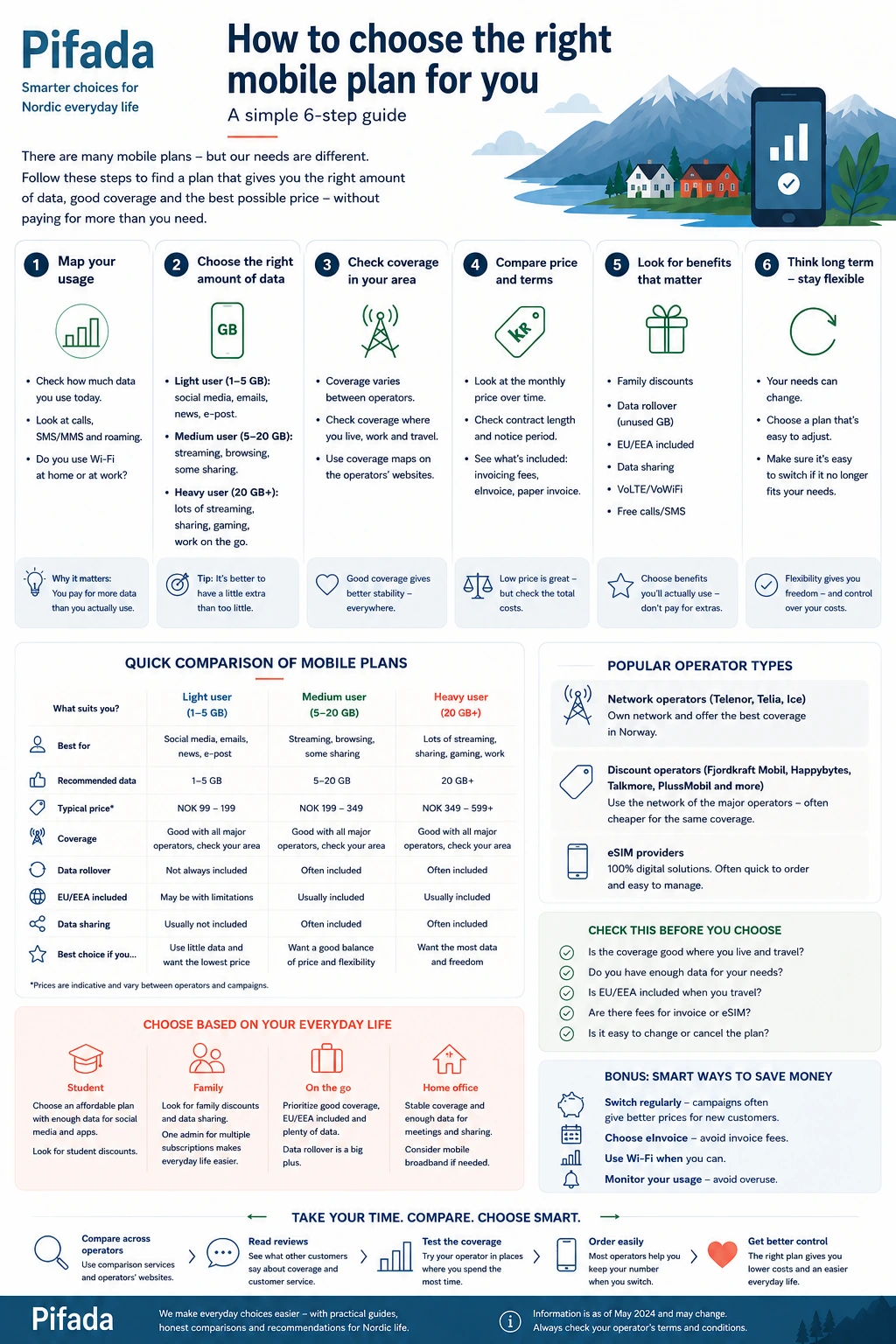
What matters when choosing a mobile plan?
It is easy to compare only price and data amount. In practice, a good mobile plan is often more about how well it works in everyday life.
For some people, a low price matters most. Others need stable coverage while commuting, simple family sharing or enough data for streaming and working from home.
The most important thing is not to find the plan with the most features, but the one that fits the way you actually use your phone.
How much data do you really use?
It is easy to choose a larger data package than you actually need.
If your phone is mostly used on Wi-Fi at home, at work or at school, a lower-cost plan with less data is often more than enough. It can work well if you:
- use social media a little during the day
- stream some music and video
- want to keep the monthly cost low
- just want something simple that works
The need looks different if you use your phone a lot outside Wi-Fi.

Data disappears faster than you may think if you:
- stream video on trains or buses
- use your phone as a hotspot
- work from the cabin from time to time
- share data with the family
Then a larger plan or unlimited data may be more practical in the long run.
Verdt å tenke på:
Et billig abonnement med lite data blir fort dyrere hvis du stadig må kjøpe ekstra datapakker.
Coverage often matters more than small price differences
Some differences only become noticeable when you use your phone outside city centres and stable Wi-Fi zones.
If you commute by train, live a little outside the city or use your phone a lot at the cabin, coverage quickly becomes more important than small differences in monthly price.
In many larger cities, several operators work perfectly well for normal use. But poor coverage is frustrating when you actually need your phone.
Good coverage is especially useful if you:
- travel a lot around Norway
- use your phone actively on the go
- work from different places
- want things to simply work without thinking about the network
If you almost always use your phone at home or in places with stable Wi-Fi, you may notice less difference between plans.
It is often smarter to pay a little more for stable coverage than to be annoyed by poor connection every week.

Unlimited data is not necessary for everyone
Unlimited data sounds safe, and for some people it makes everyday life easier.
This is especially useful for:
- heavy streaming
- gaming
- working from home on mobile data
- hotspot use
- families with high data usage
- people who do not want to keep track of data usage
At the same time, a surprising amount of mobile use in Norwegian everyday life happens on Wi-Fi. If your phone is mostly connected at home, at work or at school, a normal data package is often more than enough.
Unlimited data is therefore less useful if you:
- use little mobile data
- want to keep costs down
- mostly browse, use maps and stream a little now and then
Having as much data as possible is not necessarily cheaper. Often, it pays to find a level that actually matches your usage.

Family plans can make everyday life easier
For families with several mobile plans, it is often as much about overview as price.
Keeping the plans on one bill makes it easier to:
- track costs
- share data
- adjust needs along the way
- keep track of children’s use
This is especially useful for families with children or teenagers whose mobile use changes a lot from month to month.
If you live alone or use very little data, a family plan is often less relevant.
Some family plans look cheap at first, but extra SIM cards, data sharing or larger data packages can affect the total price more than you might expect.
eSIM and smartwatches
For most people, eSIM is not something they need to think much about. But in some situations, it makes everyday life a little easier.
eSIM is especially useful if you:
- use an Apple Watch or Galaxy Watch with mobile data
- want to avoid a physical SIM card when changing phones
- have work and private numbers on the same phone
- travel a fair amount and want to use local data packages more easily
It is especially practical for people who want to walk, exercise or run errands with a smartwatch without bringing the phone all the time.
If you use your phone in a very ordinary way, this matters much less. Then coverage, price and data amount are usually more important to prioritise.
eSIM is nice to have if you actually use the features. For normal mobile use, it often means fairly little in practice.

No binding makes it easier to switch later
A plan without a binding period gives more flexibility and less stress if your needs change.
This is especially useful for:
- students
- people who have recently moved
- people who want to test coverage first
- anyone who likes being able to adjust costs along the way
It also makes it easier to try a cheaper plan or find a solution that fits better after a few months.
Some people still choose a binding period if it gives a lower total price over time or a discount on a new phone.
Either way, it is useful to know how flexible the plan really is if your needs change later.
Which mobile plan fits different needs best?
There is no single mobile plan that is best for everyone.
Some people want the lowest possible monthly price. Others do not want to keep track of data use or need stable coverage when travelling and commuting. That is why it is often easier to start with how the phone is actually used in everyday life — not just how much data the plan promises.
Here are some typical situations worth using as a starting point.

For people who just want something simple and affordable
If you mostly use your phone for:
- messages
- a little social media
- online banking
- maps
- normal browsing
a smaller plan is often enough.
This works well for:
- adults with low data usage
- older users
- people who are almost always on Wi-Fi
- people who just want a fixed and predictable cost
For normal use, many people notice little difference as long as the coverage is stable.
At the same time, it is easy to choose too little data just to save a few kroner. If you stream video on your way to work or use your phone a lot outside home, extra data packages can quickly make the total cost higher.
For students and young adults
Student life is often about making things work without letting the phone bill grow every month.
Then it is usually smarter to look for:
- enough data for daily use
- flexibility without binding
- a simple app and clear overview
- the option to adjust the plan along the way
If you use your phone a lot on public transport, in student housing or occasionally as a hotspot for your laptop, data disappears faster than you may think.
Still, not everyone needs unlimited data. For many people, a medium-sized data package is enough if most streaming happens at home on Wi-Fi.
A flexible plan is often better than the very cheapest introductory offer.
For families with several mobile users
When several people in the family have their own plan, overview quickly becomes just as important as price.
Family plans make it easier to:
- collect costs on one bill
- share data between family members
- adjust needs as children get older
This is especially useful in families where one person uses little data and another uses a lot. You often avoid paying for large data packages for everyone.
For some families, it is also useful to follow usage without having to control it all the time.
If your usage is very different or you want completely separate solutions, individual plans may sometimes work better.
For heavy data users
Some people use their phone almost like a small home network.
Typical for:
- people who stream a lot of video
- work on the go
- use hotspot for a laptop
- commute a lot
- spend a lot of time at the cabin without stable broadband
Then it quickly becomes tiring to keep track of data usage all the time.
In these situations, unlimited data or large data packages are often worth it, even if the monthly price is higher. It gives more peace of mind than constantly checking how much data is left.
At the same time, it is worth knowing that “unlimited data” does not always mean full speed for the entire month. If you use your phone very heavily, some limits may be noticeable after a certain amount of use.
For normal streaming, social media and working from home, it still often works perfectly well.

For people who want to use a smartwatch without the phone in their pocket
eSIM is not something everyone needs to care about. But if you use a smartwatch actively, it suddenly becomes more relevant.
This is especially relevant for:
- running and training
- short walks without a phone
- everyday situations where you only want to bring the watch
- people who like having work and private numbers on one phone
Then it is worth checking whether the plan supports eSIM and smartwatch devices such as Apple Watch or Galaxy Watch.
If you use your phone in a very ordinary way, this matters much less. Then coverage, price and data amount are usually more important to prioritise.
For people who want to switch easily later
Some people simply do not want to be tied down.
This is especially useful for:
- students
- people who have recently moved
- people testing coverage in a new area
- anyone who likes being able to adjust costs along the way
A plan without binding makes it easier to try things out without it feeling like a big decision.
Data usage also often looks different during holidays, travel or after you start working from home more often.
Some people still choose binding if it gives a lower total price over time or a discount on a new phone. That is why it is smart to look at the full cost — not only the monthly price right now.
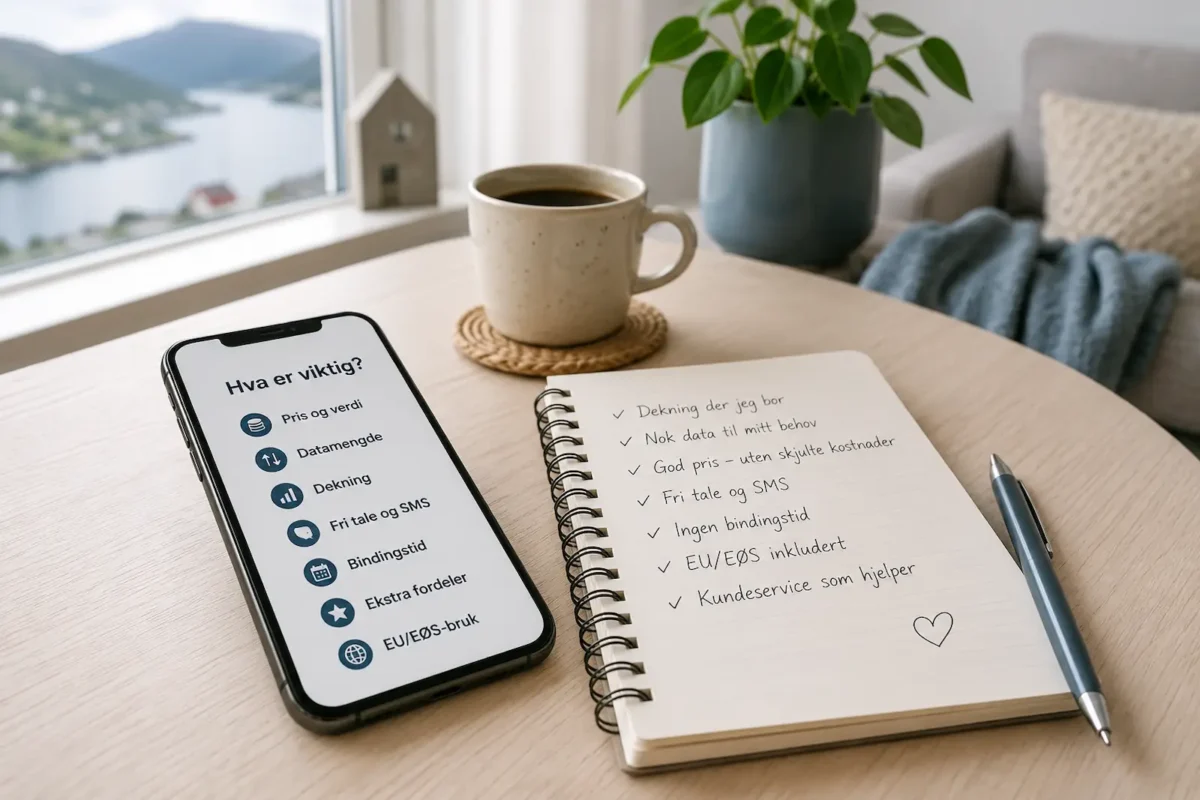
Things many people forget before switching mobile plans
It is easy to compare only price and data amount when switching plans.
But the difference is often noticeable only after a few months — when the campaign price is gone, data runs out faster than expected or the coverage does not work where you actually use your phone most.
Here are a few things worth checking before you decide.
Campaign prices rarely last forever
A plan can look very cheap at first, but the price is often temporary.
Some operators have:
- low introductory price
- extra data for the first few months
- a discount that disappears after a period
That does not automatically mean the offer is bad. But it is easy to compare a campaign price from one operator with the regular price from another.
Therefore, check:
- what the plan costs after the campaign period
- how long the discount lasts
- whether the price increases automatically later
For many people, a stable and predictable monthly price is easier to live with than constant new campaigns.
Small data packages can become more expensive than they seem
A cheap plan with little data often looks good on paper.
But if you need to buy extra data several times a month, the total price can quickly become higher than a slightly larger plan.
This is especially noticeable if the phone is used a lot:
- on trains or buses
- as a hotspot for a laptop
- for streaming outside home
- while travelling or at the cabin
For normal use, small data packages are enough for many people. But if you constantly need to track your usage, the plan may be a little too small for the way you actually use your phone.
How coverage works at home matters most
Advertising and coverage maps do not always say much about how the network actually works where you normally use your phone.
In many larger cities, several operators work well in everyday life. The difference is often more noticeable:
- at home
- at the cabin
- along your commuting route
- at work
- in places where you often use your phone during the week
If you are unsure, it is often smarter to choose flexibility first and test the plan in normal use before committing to anything long term.
Unstable coverage can quickly become more frustrating than paying a little more per month.
EU and EEA roaming is useful — but not always completely unlimited
Most Norwegian mobile plans include use in the EU and EEA. This makes it easier to use your phone on holidays and short trips without major extra costs.
Still, there are often limits on:
- how much data you can use abroad
- how long the plan is used outside Norway
- extra services and special numbers
This becomes especially relevant if you:
- work a lot from abroad
- commute between countries
- stream a lot while travelling
- use your phone as a hotspot during holidays
For normal holidays, roaming usually works perfectly well. It is mainly with high usage or longer stays that the limits become noticeable.
Notice period and binding are easy to overlook
Some people switch plans without thinking much about binding or notice period until the invoice arrives.
If you received a phone discount or a special price through the plan, there may be a binding period or extra costs for switching early.
Some people still choose a binding period if it gives a lower total price over time or a discount on a new phone.
At the same time, it is good to know how flexible the plan actually is if your needs change later.
eSIM and BankID are most relevant if you change phones often
For most people, switching between plans is fairly painless.
But if you use:
- eSIM
- BankID
- a smartwatch with mobile data
- several SIM cards
it can be useful to check how everything is set up with the new operator.
This is especially relevant if you want your watch, BankID and phone to work as usual right after switching.
For ordinary mobile use, this is rarely decisive. But it is good to be a little prepared before switching.
How Pifada evaluates mobile plans
Pifada does not sell mobile plans. Our goal is to make it easier to find a solution that fits ordinary everyday life in Norway — without more noise than necessary.
When we evaluate mobile plans, we look at things such as:
- price over time, not just campaigns
- how much data people actually need
- flexibility and binding
- how coverage works in practice
- family and eSIM solutions
- how easy the plan is to understand and use
We also try to look at the plans in practical situations:
- commuting
- student life
- family use
- working from home
- travel and cabin life
A plan does not need to be the largest or most expensive to be a good choice. Often, it is simply about finding something that fits your use without paying for more than necessary.
Affiliate links and partnerships
Pifada may earn money through some links in this guide. This does not affect how we evaluate the plans.
Instead, we try to explain which solutions fit different needs and what is worth checking a little extra before choosing.
FAQ
What is the cheapest mobile plan in Norway?
That mostly depends on how much data you actually use. If your phone is often on Wi-Fi at home and at work, a smaller plan is often enough. If you stream a lot or use your phone as a hotspot, very small data packages quickly become impractical.
Is unlimited data worth it?
Unlimited data is especially useful if you use your phone a lot outside home — for example for streaming, working from home or hotspot use while travelling or at the cabin.
For normal use, a regular data package at a lower price is often enough.
Are there mobile plans without binding?
Yes. Many plans in Norway can be used without a binding period. This makes it easier to switch later if your needs change or the coverage does not fit as well as expected.
Can I keep my number when switching plans?
Yes, in most cases your number is transferred automatically when you change operator. For most people, the switch is fairly quick and happens without you needing to do much yourself.
What does eSIM mean?
eSIM is a digital version of the SIM card in your phone. It is used for smartwatches, extra subscriptions or phones with several numbers at the same time.
For many people, it matters little in normal use, but it is worth checking if you use an Apple Watch or change phones often.
Which mobile plan works best for families?
Family plans often work well if several people in the household want to share data or collect costs on one bill. It makes it easier to adjust needs along the way and keep an overview of usage.
Final thoughts
Choose a mobile plan based on actual use.
If you are mostly on Wi-Fi, you rarely need the largest data package. If you commute, stream a lot or use your phone at the cabin, coverage and data become more important.
The right choice is the one that fits your everyday life best — not necessarily the cheapest on paper.